
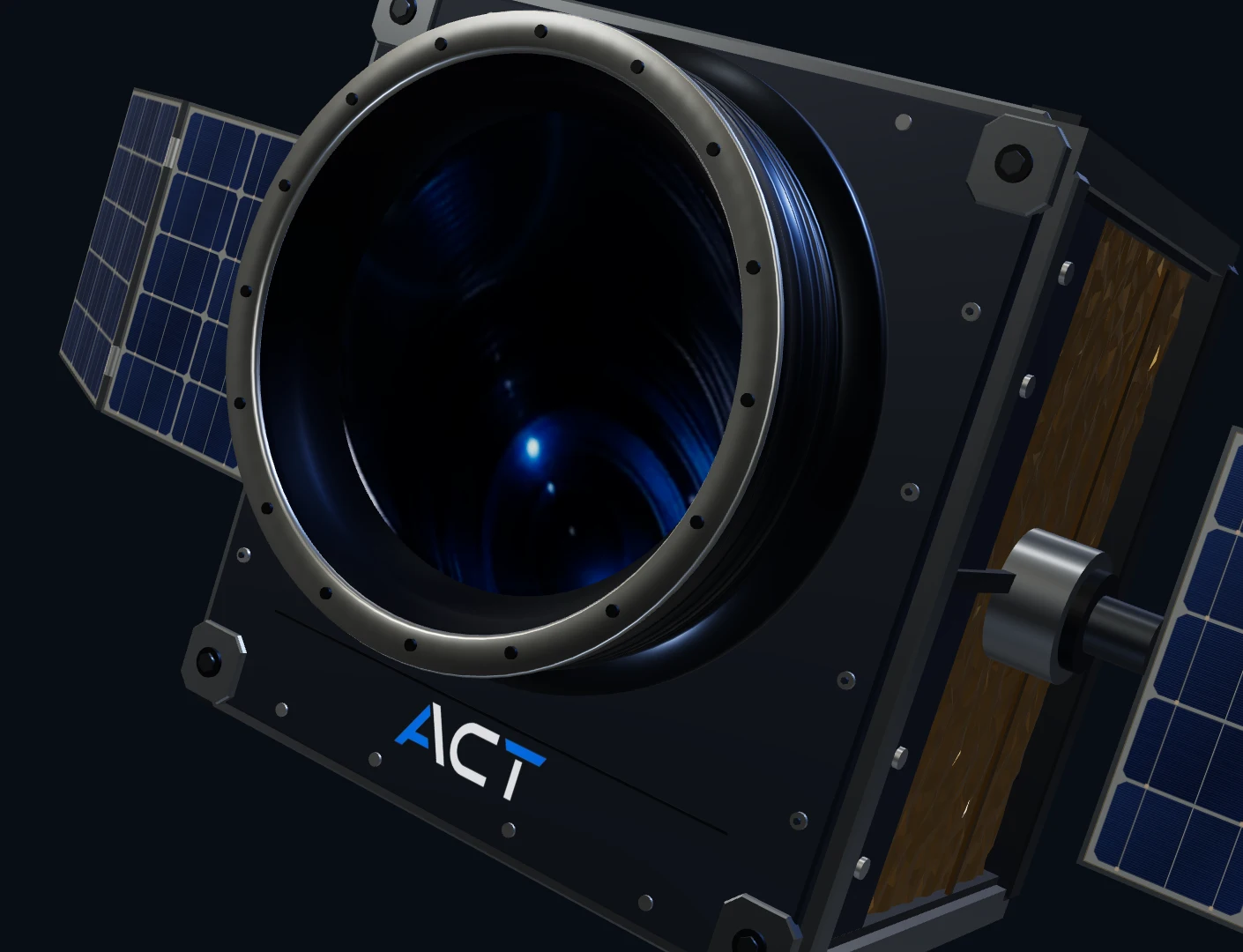
One telescope.
Six disciplines.
Inside ACT’s CubeSat constellation telescope project, engineers work on different pieces of the same observation. One change to a mount, a power budget or a command can reach all the way to the image.
Explore the assemblyFollow one observation.
ACT’s reference design is a distributed constellation of 6U CubeSats. The teams explore how several spacecraft might collect observations, process measurements on board and share data. Follow one proposed image from the instrument to the ground.
Collect light
Science defines the observation. Optics and pointing have to deliver that view to the detector.
Record a signal
Power must be available when software commands the instrument. The spacecraft also needs to record its own health.
Return the data
The team has to plan how the measurement reaches the ground and how someone will tell whether it is useful.
Look inside the CubeSat.
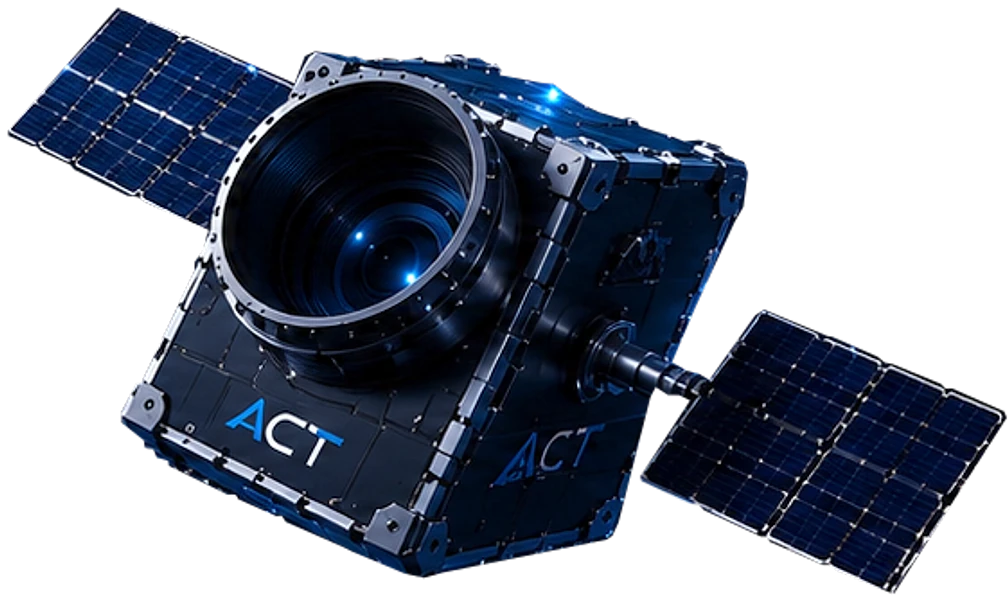
The optical housing, electronics and folding solar arrays share a compact structure. Trace where one assembly hands off to the next.
This model illustrates ACT’s telescope concept. Component proportions are illustrative.
Find your engineering question.
Inside each cohort, members can claim a project task, work through its brief and submit an artifact for review. These assignments come from the telescope project’s own task library.
- Science & research
- What observation would be useful? The science briefs ask for observation requirements, a list of data products and success criteria. Explain what the instrument would have to measure for an observation to count.
- Aerospace
- Which orbit should the design assume? Compare sun-synchronous, polar and mid-inclination orbits. Build a comparison matrix for coverage, lighting and contact opportunities, then recommend a starting point for the other teams.
- Mechanical
- What fits inside the spacecraft? Build a 6U internal layout concept, account for mass or work through the payload’s mechanical interface. Show where alignment, access and assembly constrain the layout.
- Electrical
- Is there enough power through eclipse? The preliminary power budget tracks loads by subsystem and operating mode. Make the margin visible so a reviewer can see which assumption would change the answer.
- Software
- How does the spacecraft change modes? The software briefs cover state management, telemetry and data handling. Map the transitions and the status information an operator would need if a sequence stopped.
- Systems & program management
- Do the parts still meet the mission together? Link a requirement to its verification method or document an interface between two subsystems. Trace who needs to revisit a decision when that interface changes.
A decision you can defend.
Take the orbit assignment. The brief calls for a profile of each candidate, a comparison matrix and a recommendation supported by at least three reasons. A single page of that work can show a hiring manager the trade between time in sunlight, useful observations and opportunities to send data home.
In an interview, name the design decision, the comparison you personally made and the conclusion your evidence supports. Explain which assumption you would test next. The team’s question gives the story context, and your matrix shows exactly what you contributed.
Explore ACT’s career programs